
Divorce and Separation for High-Income Professionals in North Carolina
A Legal Guide from Siemens Family Law Group
Siemens Family Law Group is a family law firm based in Asheville, North Carolina. We represent high-income professionals — physicians, surgeons, executives, and business owners — throughout Western North Carolina and statewide. Our attorneys handle cases involving complex marital estates: medical and professional practices, executive compensation packages, closely held businesses, deferred income, multiple real estate holdings, and retirement assets across a range of account types.
Cases at this income level require a different kind of representation. The stakes are higher, the financial structures are more complex, and the analytical demands — on classification, valuation and tax consequence and distribution— are substantially greater than in a typical divorce. This guide explains how North Carolina law applies across the three primary domains of high-income divorce: child custody and support, spousal support and alimony, and equitable distribution of marital assets.
Our goal in publishing this guide is straightforward: we want prospective clients to understand the law before they walk through our door. Informed clients make better decisions, reach better settlements, and get through the process more efficiently.
Who We Represent
Medical doctors and surgeons (Mission Health, private practice, employed physicians)
Executives and professionals with equity compensation, bonuses, or deferred income
Business owners and partners in closely held companies
Real estate investors and developers
High-earning professionals across Western North Carolina and statewide
I. Child Custody and Support
Custody: What High-Income Earners Should Expect
North Carolina's public policy — codified in G.S. 50-13.2 — expressly favors shared parenting. Courts no longer presume that the primary earner receives limited visitation while the primary caregiver retains sole custody. Equal or near-equal custody schedules (week-on/week-off, 5-2-2-5, and similar arrangements) are common outcomes in contested cases, and they are the starting point for negotiation in the great majority of cases we handle.
For physicians and other professionals with demanding schedules, equal custody is still entirely achievable and often in the client's financial interest as well — both because of the parenting bond it preserves and because of the effect shared custody has on the child support calculation, as described below.
Child Support Above $480,000 Combined Household Income
North Carolina's Child Support Guidelines apply directly when combined gross household income is $480,000 per year or less. Above that threshold, the guidelines stop — but the statute does not. N.C. Gen. Stat. § 50-13.4 directs courts to order support in an amount sufficient to meet the child's reasonable needs, giving "due regard to the estates, earnings, conditions, accustomed standard of living of the child and the parties, the childcare and homemaker contributions of each party, and other facts of the particular case."
In practice, the guidelines remain an essential analytical tool even at and above the income cap — not as a ceiling, but as a floor and a framework. Understanding how Worksheet B works is critical for any high-income client, because the calculation is far more nuanced than a simple percentage of the higher earner’s income. Both spouses’ incomes are factored. The custody schedule directly impacts the support obligation. Childcare and health insurance are apportioned between the parties proportional to their income shares. The result can impact the actual financial dynamics of other financial aspects of a specific case.
North Carolina Child Support Worksheet B: A Worked Example
Worksheet B is the form North Carolina courts use whenever each parent has 123 or more overnights per year — that is, any genuinely shared custody schedule. The following example is drawn from an actual Worksheet B calculation (AOC-CV-162, Rev. 1/2023) using the scenario most representative of the clients we serve: Plaintiff/Father, a physician earning $35,000 per month gross; Defendant/Mother earning $5,000 per month gross; two children; week-on/week-off custody (50% overnights each); Father paying $400 per month for the children’s health insurance; work-related childcare of $800 per month total.
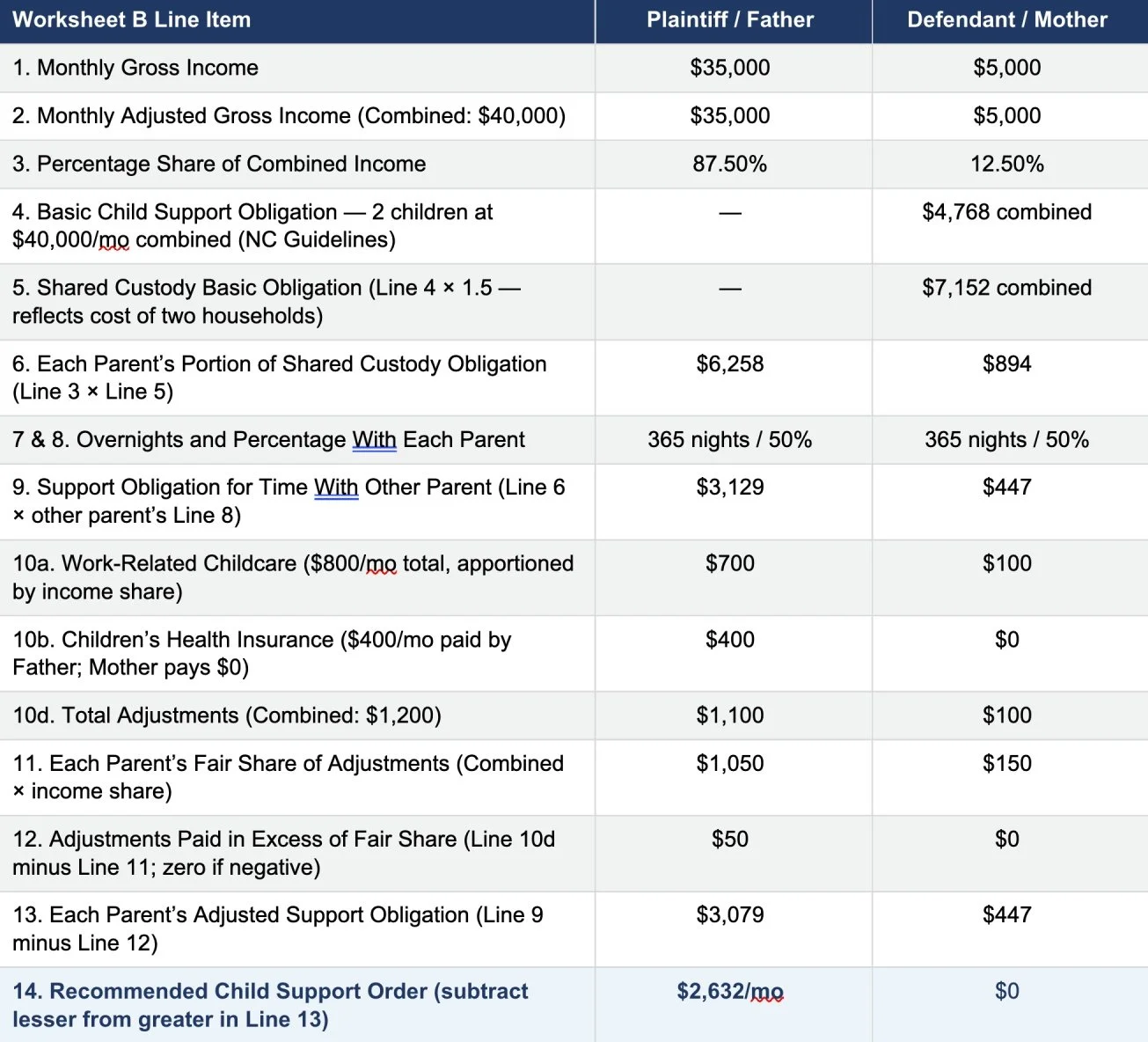
The recommended order is $2,632 per month from Father to Mother. Several things about this result deserve emphasis. First, the Mother’s income meaningfully reduces the Father’s obligation — a physician earning $35,000 per month does not pay support calculated solely on his income. His obligation is proportional to his 87.5% share of combined household income, and her 12.5% share offsets that figure throughout the calculation. Second, the shared custody schedule is itself a substantial financial variable: the 1.5 multiplier on Line 5 reflects the real cost of maintaining two separate households for the children, and the 50% overnight offset on Line 9 reduces each parent’s net obligation accordingly. Third, adjustments for childcare and health insurance are apportioned by income share — not simply credited to the parent who pays them. Father pays $1,100 in total adjustments but his fair share is $1,050; the $50 excess is credited back at Line 12.
When combined income exceeds $480,000 per year, the guidelines no longer apply directly — but Worksheet B remains the most defensible analytical foundation for negotiation. We use it as a baseline and scale the basic obligation proportionally, preserving the worksheet logic throughout, to reach a principled starting position that a court applying the statutory factors in N.C. Gen. Stat. § 50-13.4 would recognize as grounded in the same methodology the guidelines employ.
Establishing a supportable child support figure early in the process is strategically important. Child support paid by the supporting spouse is generally deducted from that spouse’s income — and added to the dependent spouse’s income — when courts calculate spousal support. Getting to a child support number first clarifies the financial picture for every subsequent conversation.
Key Insight: Custody Schedule Affects Every Financial Calculation
A shared-custody schedule reduces child support obligations compared to primary custody arrangements. It also affects the spousal support analysis by increasing the earning capacity attributed to a non-working spouse. Custody strategy and financial strategy should be considered in concert at this income level.
II. Post-Separation Support and Alimony
The Legal Framework
North Carolina distinguishes between post-separation support (PSS) — temporary support paid while the case is pending — and alimony, which is a longer-term award determined after full consideration of the parties' financial circumstances. Both are governed by Chapter 50 of the North Carolina General Statutes. There are no formulas or guidelines for either; awards are fact-specific and vary by judicial district.
To be entitled to either form of support, a spouse must qualify as a "dependent spouse" — one who is substantially dependent upon the other for maintenance and support. A supporting spouse is the party upon whom that dependency falls. These definitions matter: not every non-working spouse qualifies as dependent, and courts have increasing latitude to impute income to a spouse who is capable of working but chooses not to.
What Courts Actually Weigh in Alimony Cases
The alimony statute (N.C. Gen. Stat. § 50-16.3A) lists sixteen factors courts must consider. In our experience litigating and settling alimony cases across Western North Carolina, two factors consistently carry the most weight:
Relative earnings and earning capacities of the spouses (Factor 2)
Duration of the marriage (Factor 5)
Where incomes are approximately equivalent, or where the marriage lasted fewer than ten years, courts in our district are generally disinclined to award alimony. Longer marriages — particularly those of fifteen or more years — with substantial income disparities are where alimony exposure is greatest.
Marital misconduct, including illicit sexual behavior, is a factor — but it functions differently depending on which spouse committed it. Uncondoned illicit sexual behavior by the dependent spouse is a complete bar to alimony under North Carolina law. The same conduct by the supporting spouse does not automatically mandate alimony but is a factor the court must consider in determining amount and duration.
Negotiation and Settlement
Because outcomes are uncertain and litigation is expensive, the great majority of alimony cases settle. Common settlement frameworks in our practice include:
Income equalization for a defined term (often one-third to one-half the length of the marriage in months)
Lump-sum settlements in lieu of periodic payments, particularly where the marital estate is large enough to support it
Contractual alimony with defined downward modification triggers (e.g., involuntary income reduction), which cannot be subsequently modified by a court
Contractual alimony — a negotiated agreement as opposed to a court order — is an important tool for the supporting spouse. A court-ordered alimony award is subject to modification if circumstances change. A carefully drafted contractual obligation, by contrast, is enforceable on its own terms and can include protections a court order cannot provide.
Alimony terminates by statute upon the death of either party, or upon the dependent spouse's remarriage or cohabitation. These termination events are critical considerations before agreeing to lump-sum payments.
Reducing Alimony Exposure Through Property Settlement
In high-net-worth cases, alimony exposure can often be substantially reduced or eliminated through the structure of the equitable distribution settlement. An unequal division of marital assets in favor of the dependent spouse — or a substantial distributive award — can satisfy the court that the dependent spouse's reasonable needs are met without ongoing periodic payments. This is one of the most important strategic intersections between the alimony and equitable distribution analyses.
III. Equitable Distribution: Dividing the Marital Estate
How North Carolina Classifies Property
North Carolina is an equitable distribution state, not a community property state. Not all assets are subject to division. The law recognizes three categories:
Marital property: Assets and debts acquired during the marriage through active effort, presumed to be divided equally
Separate property: Assets owned before marriage, or received by gift or inheritance during the marriage from a third party — not subject to division
Divisible property: Post-separation changes in value of marital assets attributable to market forces (not either party's effort) — subject to division
The four-step process is: (1) identify all assets and debts as of the date of separation; (2) classify each as marital, separate, or mixed; (3) value marital assets as of the date of separation; and (4) distribute equitably, with equal division as the starting presumption under N.C. Gen. Stat. § 50-20(c).
Where High-Net-Worth Cases Get Complex
In most cases, identification and valuation are straightforward. In high-income professional cases, they are not. The three areas of recurring complexity in our practice are:
Medical and professional practice valuation. A physician's practice may have been established before marriage, grown substantially during the marriage, and now represent the largest single asset in the estate. Classification depends on the source of growth — passive appreciation of a pre-marital asset versus active marital effort. Valuation is contested when appraisers weight income, market, and asset approaches differently. These disputes require experienced forensic accountants and attorneys who understand the methodologies.
Executive compensation. Stock options, restricted stock units, deferred compensation, and performance bonuses that span the separation date present classification challenges. The formula most commonly applied in North Carolina allocates the marital fraction of unvested awards based on the ratio of marital service to total vesting period — but that formula is not statutory and its application is contested.
Mixed assets and tracing. When separate property (pre-marital savings, an inheritance) is commingled with marital assets — as often happens with down payments, business capital contributions, or investment accounts — the separate property claim must be traced with documentation. Without adequate records, the presumption runs against the party claiming separate property.
The Equitable Distribution Worksheet
Good equitable distribution practice is built on a working spreadsheet. The worksheet below illustrates the four-step analysis for a medical professional with a complex marital estate. This is a simplified example; actual cases involve more assets, more debt, and more classification disputes.
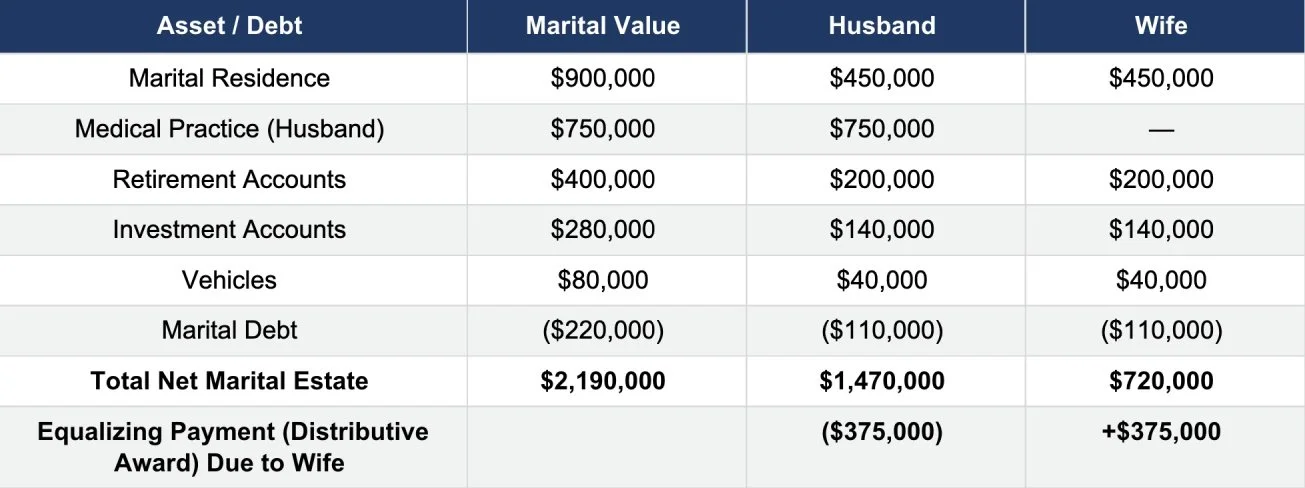
In this example, the husband retains his medical practice and the bulk of marital assets. An equalizing distributive award to the wife brings the division to approximate equity. Once a working worksheet exists, settlement discussions become data-driven rather than positional — and the parties can test different scenarios in real time.
Tax Consequences Matter
The equitable distribution statute (§ 50-20(c)(11)) expressly requires courts to consider the tax consequences to each party. In high-income cases, those consequences are material. A dollar in a pre-tax retirement account is not worth the same as a dollar in a taxable brokerage account. Embedded capital gains in appreciated real estate or securities reduce the real value of those assets. Practice goodwill — if included — may not be liquid. Proper equitable distribution analysis accounts for after-tax values, not just face values.
Our Approach to Equitable Distribution
We build a working equitable distribution worksheet from the first client meeting and maintain it throughout the case. As new information emerges — updated account values, forensic valuations, post-separation asset changes — the worksheet reflects it. Settlement offers are exchanged in worksheet form. Clients understand exactly what they are agreeing to.
IV. Why Siemens Family Law Group
Our firm handles high-net-worth divorce cases every day. The cases we are most frequently retained for involve one or more of the following:
Physician and surgeon divorces, including practice valuation and buy-sell agreement analysis
Executive divorces involving stock compensation, deferred income, or partnership interests
Cases with business ownership, professional licenses, or closely held company interests
Long-duration marriages with substantial alimony exposure
Cases requiring forensic accounting, expert valuation, or financial discovery
We understand the range of outcomes that courts in our district produce. We have the case history to advise clients on realistic settlement ranges for child support, alimony, and equitable distribution — not just the law in the abstract. And we understand how the three financial domains interact: a decision made in custody affects child support; child support affects alimony; alimony affects what a property settlement needs to accomplish.
We are based in Asheville and serve clients throughout Western North Carolina, including Buncombe, Henderson, Haywood, Madison, McDowell, Polk, Rutherford, and Transylvania counties. We also accept statewide referrals for complex, high-value cases.
Schedule a Consultation
This guide provides an overview of how North Carolina law applies to high-income divorce cases. It is not legal advice, and every case is different. The facts of your situation — the length of your marriage, the structure of your income, the nature of your assets, and the details of your separation — will determine how the law applies to you.
We encourage you to schedule a consultation with Siemens Family Law Group to discuss your specific circumstances. Initial consultations are confidential. We will tell you what we see, what the realistic range of outcomes looks like, and what it will take to get there.
Click to download a PDF of Siemens Family Law Group’s “Divorce and Separation for High-Income Professionals in North Carolina” legal guide.
This guide reflects North Carolina law as of 2026. It is provided for general informational purposes only and does not constitute legal advice or establish an attorney-client relationship.